
OpenAI is taking another major step toward autonomous shopping with ChatGPT Wallet, a new payment solution designed to let artificial intelligence agents purchase products on behalf of users without exposing their actual credit card information. Developed alongside major payment networks, the system aims to make AI-powered shopping safer, more convenient and easier to integrate with online retailers.
The announcement represents an important development in the growing field of agentic commerce, where AI assistants do more than recommend products. They can potentially search for items, compare prices, manage shopping carts and complete transactions. With ChatGPT Wallet, OpenAI wants to connect product discovery directly with secure payments.
What Is OpenAI ChatGPT Wallet?
ChatGPT Wallet is a digital payment solution developed by OpenAI in collaboration with American Express, Mastercard and Visa. Its main purpose is to allow AI agents to make purchases without giving them direct access to a user’s real credit card number, expiration date or security code.
Instead of sharing sensitive payment information with an AI system, the wallet uses payment tokens generated by the card network. These tokens act as substitutes for actual card details and can be used to process transactions through supported payment systems.
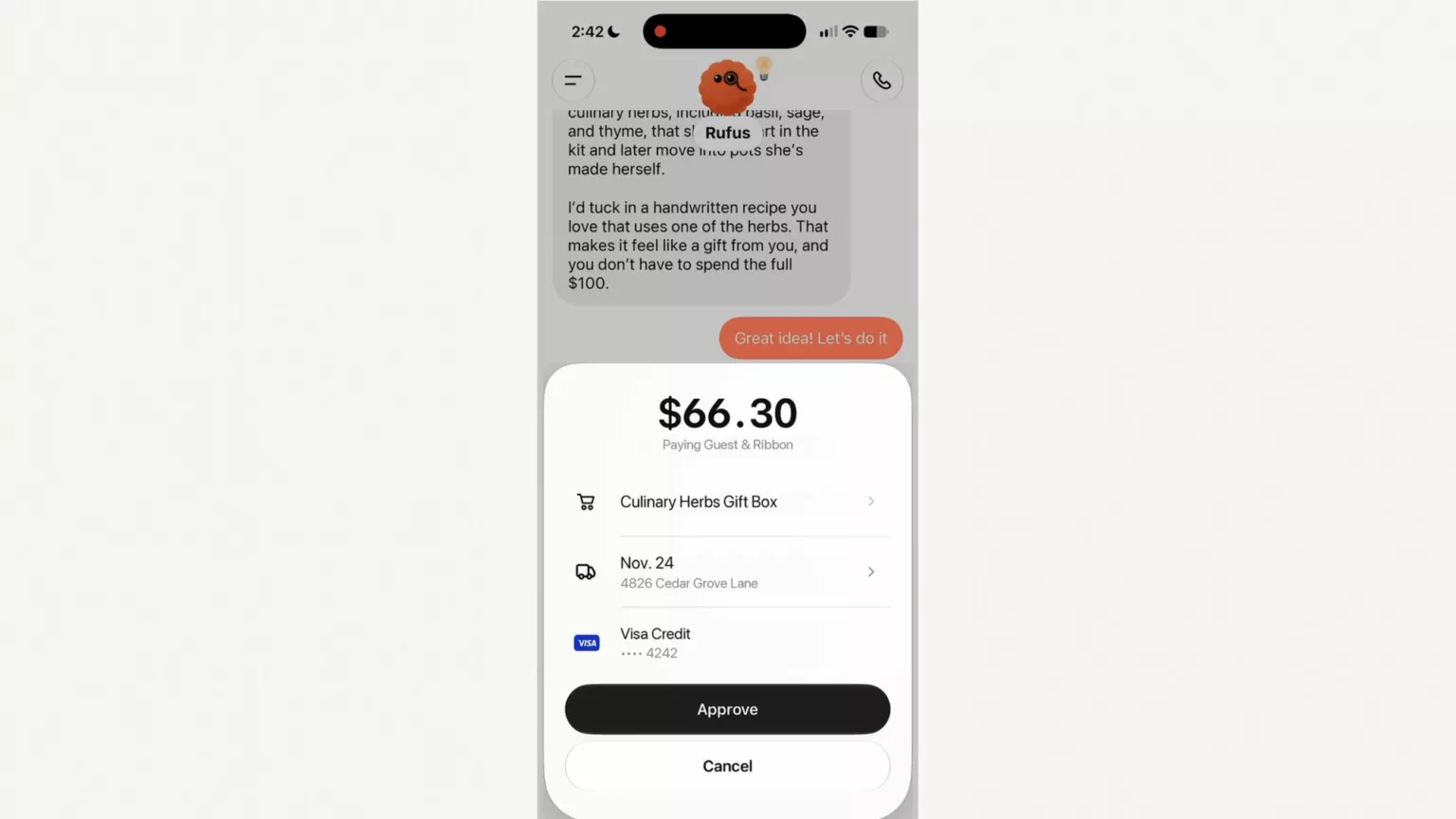
OpenAI describes the wallet as a way to combine autonomous purchasing with security controls. Each transaction initially requires an explicit user approval, creating a record of what the AI agent has been authorized to buy.
How Does ChatGPT Wallet Work?
The payment process is designed to give users control over purchases while allowing AI agents to handle much of the shopping process. Users add an eligible credit card to their wallet once and then authorize transactions when their agent is ready to complete an order.
- Add a payment card. Users register an eligible American Express, Mastercard or Visa card in ChatGPT Wallet.
- Let the AI agent prepare the purchase. The agent identifies the selected products and presents the items, total cost and payment card to the user.
- Approve the transaction. The user confirms the purchase using a biometric security method, such as Face ID or fingerprint authentication.
- Generate a payment token. The card network creates a token with its own payment credentials instead of exposing the original card information.
- Complete the payment. The merchant processes the transaction using the token, and the charge is applied to the user’s stored payment card.
According to OpenAI, neither the AI agent nor the merchant receives the user’s actual card details through this payment process. The system is also designed to preserve eligible card rewards and applicable purchase protections.
Why Payment Tokenization Matters for AI Shopping
Payment tokenization is an important security technology because it replaces sensitive card information with an alternative set of credentials. This can reduce the exposure of financial information when transactions are processed through digital services.
For AI-powered shopping, this distinction is especially important. An autonomous agent needs permission to complete a purchase, but it does not necessarily need access to the user’s underlying financial credentials.
Which Credit Cards Does ChatGPT Wallet Support?
At launch, ChatGPT Wallet supports eligible American Express, Mastercard and Visa cards issued by banks in the United States.
| Payment Network | Launch Support |
|---|---|
| American Express | Supported |
| Mastercard | Supported |
| Visa | Supported |
| PayPal | Not announced |
| Apple Pay | Not announced |
| Bank transfers | Not announced |
| Cryptocurrency | Not announced |
American Express describes the integration as the first implementation of its agentic commerce program. The company also plans to make the experience available to additional card members after the initial rollout.
Where Is ChatGPT Wallet Available?
ChatGPT Wallet is initially launching in the United States with limited availability. According to the announcement, access is restricted to ChatGPT Pro subscribers aged 18 or older who have an eligible U.S.-issued payment card.
The wallet is being introduced through Dots, OpenAI’s personal AI agent designed to operate continuously using its own cloud computer. This integration allows the agent to handle tasks beyond traditional conversations, including research, online shopping and other digital activities.
OpenAI has not announced a specific launch date for the European Union or other international markets. The company intends to learn from early users and expand the service in collaboration with merchants, banks and payment networks.
Can AI Agents Make Purchases Without Asking Every Time?
One of the longer-term goals of ChatGPT Wallet is to support more autonomous shopping. Instead of requiring users to approve every individual transaction, OpenAI plans to introduce purchasing rules that allow agents to operate within predefined limits.
Users could potentially configure spending limits, approved product categories and specific time periods during which an agent is allowed to make purchases.
These permissions would be supported by biometric security checks, helping users establish boundaries before delegating more shopping responsibilities to an AI assistant.
This approach could make it possible to automate routine purchases, find products within a budget or complete orders when specific conditions are met. However, the availability and exact functionality of these features will depend on OpenAI’s future rollout.
What Online Merchants Need to Know About AI Shopping
ChatGPT Wallet could create new opportunities for e-commerce businesses, but merchants also need to prepare their websites and payment systems for transactions initiated by AI agents.
OpenAI acknowledges that some websites, security systems and payment platforms may unintentionally block automated shopping activity. To address this challenge, the company is encouraging retailers to adopt several technical practices.
1. Improve Product Data and Availability
Businesses can claim their profiles in ChatGPT and provide product feeds containing updated prices, descriptions and inventory information. Accurate product data makes it easier for AI agents to identify relevant products and present reliable shopping options.
2. Allow Verified AI Agent Access
Firewalls and content delivery networks should be configured to recognize authenticated requests from ChatGPT agents. OpenAI points to Web Bot Auth as a standard that can help websites identify signed requests from legitimate automated agents.
3. Adapt Fraud Prevention Systems
Even when a transaction uses a valid payment token, fraud detection systems could mistakenly identify AI-initiated purchases as suspicious. OpenAI is working with companies such as Forter, Riskified, Sardine and Signifyd, as well as payment providers including Adyen, Checkout.com and Stripe.
4. Build Interfaces for AI Agents
Merchants can develop plugins that allow AI agents to check product availability, interact with shopping carts and perform other commerce-related tasks. They can also explore WebMCP tools to make website functionality more accessible to automated assistants.
Why AI Shopping Has Not Become Mainstream Yet
Despite the growing interest in autonomous AI agents, real-world adoption of agentic commerce remains relatively limited. Consumers may use AI to research products, compare prices and discover services, but allowing software to complete financial transactions is a different challenge.
Industry examples illustrate the gap between AI shopping ambitions and actual purchasing activity. Reports have highlighted limited agent-generated bookings across services such as Uber, Airbnb, DoorDash and Booking.
Another obstacle is retailer resistance. Amazon, for example, has restricted access by Meta’s Muse shopping agent, while major financial institutions such as JPMorgan Chase and Charles Schwab have taken measures to block certain AI agents attempting to access customer financial accounts.
These restrictions demonstrate why secure authentication and transparent payment authorization are essential for the future of AI commerce.
OpenAI vs. Meta and Anthropic: The Race for AI Shopping
OpenAI is entering a competitive market in which several technology companies are developing AI agents capable of interacting with online services and completing tasks.
| Company | AI Shopping Initiative | Main Focus |
|---|---|---|
| OpenAI | ChatGPT Wallet and Dots | Shopping research and secure payments |
| Meta | Muse and Personal Agent Protocol | AI-powered retail shopping |
| Anthropic | Claude Duet | Personal AI assistance |
| xAI | Grok Bot | Autonomous AI capabilities |
Meta is working with Walmart on the Personal Agent Protocol, an initiative intended to establish a framework for AI agents interacting with retailers. Anthropic has also introduced Claude Duet, while Elon Musk’s xAI continues developing its Grok-based AI ecosystem.
OpenAI’s approach stands out because it connects product discovery with a dedicated payment infrastructure. Rather than simply helping users decide what to purchase, ChatGPT could eventually become an assistant capable of completing the entire buying process.
What ChatGPT Wallet Could Mean for the Future of E-Commerce
The introduction of ChatGPT Wallet highlights a potential shift in how people interact with online stores. Traditional e-commerce requires customers to visit websites, search for products, compare alternatives, add items to shopping carts and enter payment information.
AI agents could simplify this experience by understanding a user’s requirements and handling several steps automatically. A customer might ask an assistant to find a laptop within a particular budget, compare available models and prepare the best option for purchase.
With secure payment infrastructure, the agent could eventually complete the transaction within clearly defined permissions.
However, widespread adoption will depend on consumer trust, merchant compatibility, reliable fraud prevention and the ability of payment networks to support automated transactions at scale.
For online retailers, this development could make product information, inventory accuracy and AI accessibility increasingly important parts of their digital commerce strategies.
Frequently Asked Questions About ChatGPT Wallet
What is ChatGPT Wallet?
ChatGPT Wallet is an OpenAI payment solution designed to let AI agents make authorized purchases using payment tokens instead of accessing users’ actual credit card information.
Is ChatGPT Wallet safe?
The system is designed to improve payment security through tokenization and biometric transaction approval. However, users should still review purchase details and understand the permissions granted to their AI agents.
Does ChatGPT Wallet store credit card information?
Users add an eligible card to the wallet. The AI agent does not receive the actual card details when processing purchases through the tokenization system.
Can I use PayPal with ChatGPT Wallet?
PayPal was not included among the supported payment methods in OpenAI’s initial announcement. The launch focuses on eligible American Express, Mastercard and Visa cards issued by U.S. banks.
Is ChatGPT Wallet available outside the United States?
The initial rollout is limited to eligible users in the United States. OpenAI has not provided a confirmed international launch schedule.
Can ChatGPT buy products automatically?
The initial experience requires approval for each purchase. OpenAI plans to introduce additional controls that could allow agents to make purchases within user-defined spending limits and other restrictions.
Which AI agent uses ChatGPT Wallet?
The wallet is launching through Dots, OpenAI’s personal agent designed to perform tasks continuously using a cloud computer.
Do merchants need to change their payment systems?
Payment tokens are designed to work with existing checkout systems, but merchants may need to adjust their security configurations, product feeds and fraud detection processes to accommodate AI-initiated purchases.
Final Thoughts: Is ChatGPT Wallet the Future of AI Payments?
OpenAI’s ChatGPT Wallet represents a significant development in the evolution of digital payments and autonomous shopping. By combining AI-powered product research with tokenized transactions and biometric approval, the company is attempting to address one of the biggest barriers to agentic commerce: giving software the ability to spend money without exposing sensitive financial information.
The initial U.S.-only rollout is still limited, and widespread adoption will depend on cooperation between banks, payment networks, retailers and technology providers. Nevertheless, ChatGPT Wallet could help establish a new model in which AI assistants become active participants in online shopping rather than simply tools for finding information.
If OpenAI can make this experience secure, reliable and convenient, AI-powered purchasing could become an important part of the future e-commerce landscape.
Information is based on the announcement and product details provided for this article. Supported features, eligibility requirements and availability may change as OpenAI expands the service.