
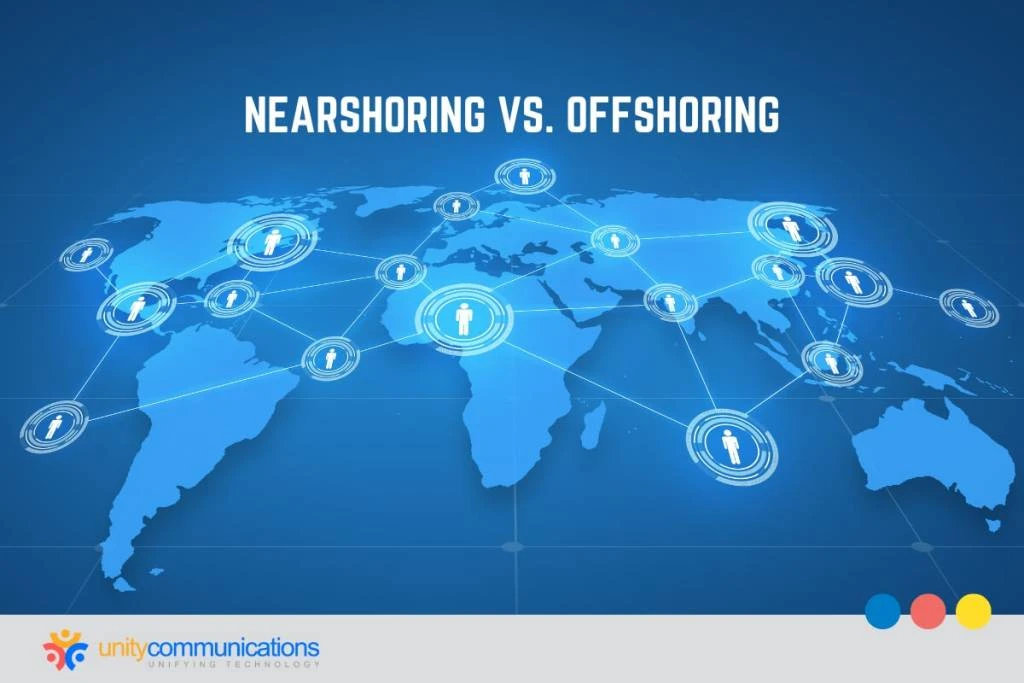
The global business landscape has undergone a seismic shift. The hyper-globalized supply chain model that dominated the early 21st century — built on the premise that the cheapest labor wins, regardless of distance — is being dismantled and rebuilt from the ground up. In its place, a new strategic logic is emerging: one that prioritizes resilience, speed, and operational compatibility over pure cost arbitrage. At the center of this transformation sits Europe — and specifically Central and Eastern Europe — which is rapidly consolidating its position as the world’s most dynamic nearshoring hub. For companies re-evaluating their global operating models in 2026, understanding the nearshoring vs offshoring debate has never been more urgent.
Defining the Models: Nearshoring, Offshoring, and Onshoring
Before examining why Europe is winning, it’s essential to understand what distinguishes these operating models.
Offshoring means relocating business functions — manufacturing, software development, customer service, data processing — to a geographically distant country, typically in Asia, to capitalize on significantly lower labor costs. India, the Philippines, Vietnam, and China have historically been the primary destinations. The defining characteristic is maximum cost reduction, achieved by accepting the tradeoffs of time zone differences, cultural friction, and complex supply chain logistics.
Nearshoring keeps operations regional — outsourcing or relocating functions to nearby countries with lower costs but maintaining geographic, cultural, and time zone proximity. For Western European companies, this means Central and Eastern Europe (CEE). For North American companies, Mexico and Latin America serve equivalent functions.
Onshoring brings everything back home — repatriating operations to the domestic market. This maximizes control and eliminates cross-border complexity but typically comes at the highest cost.
In practice, the smartest companies in 2026 are deploying hybrid models — using offshore teams for execution-heavy, well-specified workstreams while building nearshore European teams for discovery-oriented work, stakeholder-dependent collaboration, and roles requiring deep contextual understanding.
Why the Offshoring Model Is Under Pressure
Offshoring’s dominance was built on a simple cost equation that is now being aggressively challenged by a convergence of structural forces.
Rising wages in traditional offshore destinations have progressively eroded the cost advantage. In India, annual wage inflation for software engineers has averaged 8–12% over the past decade. In China, manufacturing labor costs have tripled since 2005. The gap between offshore and nearshore labor costs has narrowed significantly, weakening the primary justification for accepting the associated operational complexity.
Supply chain disruption has been the defining business story of the post-pandemic era. COVID-19 exposed the catastrophic fragility of extended global supply chains — the just-in-time model collapsed when container shipping bottlenecks, port congestion, and factory shutdowns cascaded simultaneously across intercontinental networks. Companies learned an expensive lesson: efficiency gained through offshoring can be obliterated in hours by a single geopolitical shock or logistics disruption.
Geopolitical risk has become a board-level concern. The US-China trade war, Russia’s invasion of Ukraine, and escalating US tariff policies under the Trump administration have all demonstrated that trade relationships that appear stable can be weaponized as geopolitical instruments overnight. A manufacturing operation in Shanghai or a technology team in Beijing carries strategic risk that cannot be fully hedged.
Quality and IP protection concerns have also accumulated. Offshoring complex, innovation-dependent work to jurisdictions with weaker intellectual property frameworks creates ongoing exposure that is difficult to quantify but deeply material for technology, pharmaceutical, and advanced manufacturing companies.
Europe’s Nearshoring Proposition: A Multi-Dimensional Advantage
Central and Eastern Europe has emerged as the answer to offshoring’s limitations — not by competing purely on cost, but by offering a fundamentally different and more compelling value proposition.
Cost Competitiveness That Remains Real
While CEE is not as cheap as India or Vietnam, the cost advantage over Western Europe remains substantial and economically meaningful. Businesses in Germany, Italy, and Scandinavia routinely save around 40% on development and production costs by nearshoring to Eastern Europe compared to hiring domestically. In manufacturing, a factory in Slovakia, Romania, or Poland can deliver total cost structures — including labor, logistics, compliance, and quality assurance — that are highly competitive with Asian alternatives once all costs are accounted for.
Operational Compatibility and Cultural Alignment
What differentiates European nearshoring most powerfully is operational compatibility. Work culture, communication style, code quality expectations, management norms, and business ethics closely mirror those of Western Europe and North America. This compatibility is not cosmetic — it fundamentally reduces friction, accelerates decision-making, and enables nearshore teams to behave like genuine internal extensions of the business rather than external vendors operating in a black box.
Language barriers, while not entirely absent, are far less pronounced than in distant offshore locations. English proficiency across CEE countries is high, particularly among the engineering and professional services workforce. Cultural traditions around work ethic, deadline respect, and stakeholder communication align closely with Western European expectations.
Time Zone Synchronization
This is perhaps the most underestimated operational advantage of European nearshoring. Teams in Warsaw, Prague, Bucharest, or Budapest operate in the same or adjacent time zones as clients in London, Frankfurt, Paris, and Amsterdam. This means real-time collaboration, same-day problem resolution, and synchronized sprint cycles — eliminating the asynchronous communication delays and overnight escalation processes that plague offshore relationships.
For technology companies running agile development processes, the ability to conduct live daily standups, spontaneous video calls, and reactive troubleshooting sessions with nearshore teams is transformative. The same is true for manufacturing operations, where supply chain responsiveness and engineering collaboration demand low-latency communication.
EU Membership and Regulatory Alignment
For companies operating within the European single market, the EU membership of key CEE nearshoring destinations — Poland, Czech Republic, Romania, Hungary, Slovakia, Bulgaria — is a decisive competitive advantage over non-EU alternatives like Turkey or Morocco. EU membership means:
- Tariff-free movement of goods across all 27 member states
- Harmonized regulatory and legal frameworks that eliminate the compliance complexity of cross-border operations
- Consistent intellectual property protections governed by EU law
- GDPR-aligned data handling without the complex data transfer mechanisms required for non-EU jurisdictions
- Access to EU structural funds that improve infrastructure and workforce quality in nearshore destinations
A factory in Slovakia can reach Munich in under 10 hours by truck. Products assembled in Romania can be in Italy or France within days — not weeks. For time-sensitive industries like automotive, electronics, and fast fashion, this speed is a competitive differentiator that no distant offshore location can replicate.
The CEE Countries Leading the Nearshoring Revolution
Poland: The Scale Leader
Poland is the undisputed heavyweight of European nearshoring. With a developer community of hundreds of thousands, a robust technical university pipeline, and a manufacturing sector that has attracted global automotive, electronics, and defense investment, Poland offers nearshoring at scale. The country’s 3.5% GDP growth in 2026, expanding infrastructure, and pro-business investment environment make it the first destination companies evaluate when considering European nearshoring.
Czech Republic: Stability and Technical Excellence
Czechia has carved out a reputation as the most stable nearshoring destination in Europe. Its developer market — comprising over 150,000 engineers and 7,700 software firms — is defined by maturity and low turnover rates of approximately 18%, one of the continent’s lowest. For companies undertaking long-term R&D projects that require continuity and deep institutional knowledge, the Czech Republic offers unmatched operational stability.
Romania: Fast-Rising Talent Hub
Romania has transformed its economic narrative in recent years. Its technology workforce is young, highly educated, and growing rapidly — the country’s technical universities produce thousands of engineers annually, and salaries remain significantly below Western European benchmarks. Romania’s 30% stock market return in 2025 reflects broader confidence in the country’s economic trajectory, and EU-funded infrastructure investment is progressively improving logistics and connectivity.
Hungary: Manufacturing’s New Frontier
Hungary has emerged as a critical destination for manufacturing nearshoring, recording a 140% rise in manufacturing investment over five years. BYD, the Chinese EV manufacturer, chose Hungary for its first European production plant — a strategic signal of the country’s attractiveness as an EU-compliant manufacturing base for Asian companies seeking European market access. The automotive, electronics, and battery supply chain sectors are particularly concentrated.
North Macedonia and Albania: The Emerging Alternatives
For companies seeking even lower cost points while maintaining European proximity and cultural alignment, North Macedonia and Albania are gaining traction as nearshoring destinations. Both offer strong STEM education systems, competitive labor costs, and geographic proximity to Southern European markets — representing the next wave of nearshoring expansion beyond the established CEE tier.
Manufacturing Nearshoring: The Industrial Comeback
The nearshoring trend extends well beyond software and technology services. Global manufacturers are fundamentally restructuring their production geographies in response to supply chain vulnerabilities and rising Asian costs.
According to Inverto research, 57% of companies already source goods from Eastern Europe, and 32% plan to relocate production activities to the region in the coming years. This is not speculative — it is happening now. A major French automotive brand invested €400 million to expand Turkish operations into an EU export hub. BYD is building in Hungary. German automotive suppliers are establishing secondary production facilities in Slovakia and Romania as hedges against concentration risk in their existing Asian supply chains.
Central Europe, once primarily seen as an entry-level manufacturing zone, now brims with capabilities for high-end industrial projects — from electric vehicle battery systems to advanced semiconductor components. The region’s evolution from low-cost assembly to sophisticated manufacturing mirrors the development trajectory that South Korea and Taiwan followed decades earlier.
The Strategic Framework: When to Choose Which Model
The nearshoring vs offshoring decision is not binary — it is a portfolio optimization exercise that depends on the specific characteristics of each business function:
| Factor | Offshoring (Asia) | Nearshoring (Europe) |
|---|---|---|
| Cost priority | Maximum savings | Moderate savings (40% vs domestic) |
| Collaboration needs | Low (defined specs) | High (agile, iterative) |
| Time zone tolerance | Can manage async | Requires real-time |
| IP sensitivity | Moderate risk | Strong EU protections |
| Regulatory alignment | Complex for EU ops | Seamless within EU |
| Logistics speed | Weeks | Days |
| Cultural fit | Requires management | Natural alignment |
The structural forces driving European nearshoring — supply chain resilience imperatives, geopolitical risk awareness, rising Asian costs, and the operational premium of cultural and time zone alignment — are secular trends, not cyclical ones. They will continue to intensify regardless of short-term macroeconomic fluctuations.
For global businesses, the strategic question is no longer whether to incorporate European nearshoring into their operating model, but how quickly they can do so effectively. 55% of European organizations had already increased their nearshoring activity in the 12 months prior to 2026, signaling that the window of early-mover advantage is narrowing. Companies that act decisively — selecting the right CEE destinations, building the appropriate governance frameworks, and treating nearshore teams as genuine organizational assets rather than cost-reduction levers — will build durable competitive advantages that pure offshoring strategies simply cannot replicate.
Europe is no longer just a market to sell into. It is the world’s most strategic operational hub — and the companies that recognize this first will define the industrial and digital landscape of the decade ahead.